Let us tell you a story about education.
A bean seed and a raised hand
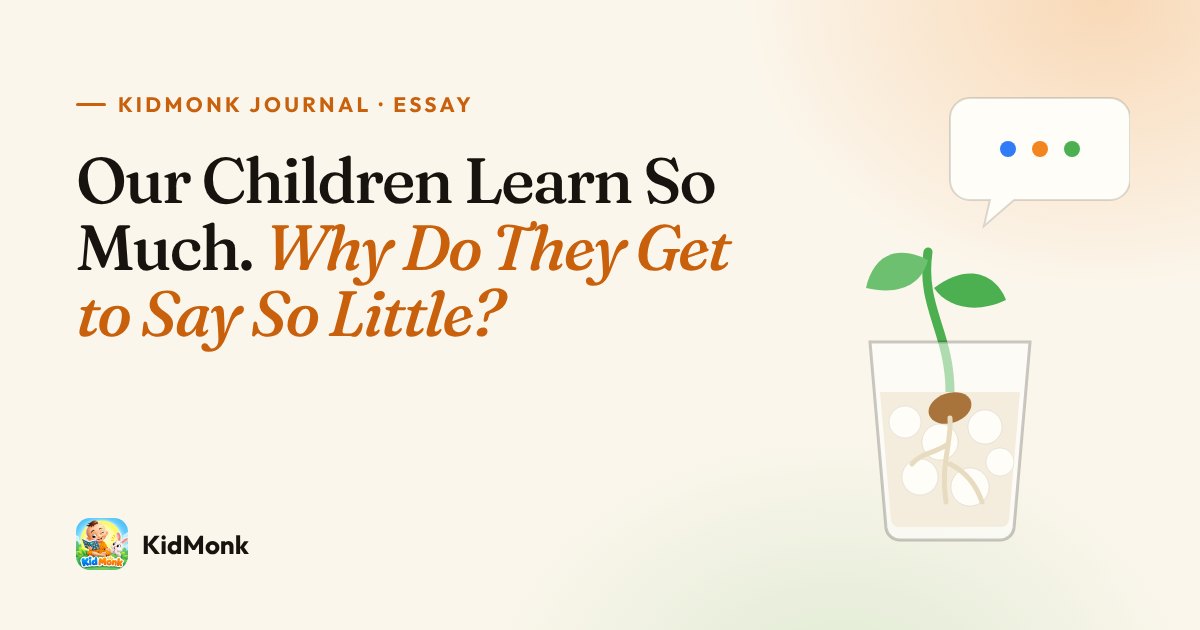
It is a Tuesday afternoon. The ceiling fan turns slowly over a class of forty, stirring the chalk dust that hangs in a slant of sunlight. On the teacher’s table sits a glass tumbler packed with wet cotton, and pressed against the glass, a single bean seed.
A week ago, the seed sprouted. A thin white root crept downward. A pale green shoot curled upward. Then the teacher did something that made eight-year-old Meera sit up straight: she laid the tumbler on its side.
Over the next few days, the class watched something almost magical. The root bent and turned until it was pointing down again. The shoot curved until it was reaching up again. A plant, it turns out, can sense gravity. Its roots grow toward the pull of the earth, and its shoots grow away from it, no matter which way the seed is lying.
Meera understood. Not the way you understand something you have memorised, but the way you understand something you have seen with your own eyes. Her mind was racing with it. And she had a question too: if a seed were planted upside down, would it still find its way?
Her hand shot up.
The teacher smiled and called on three children before her. Each gave a short, correct answer. Then the bell rang.
That evening, Meera’s mother set down a steel tumbler of milk and asked, in their mother tongue, “What did you learn today?” Meera began to explain, but the words she had heard in class, “gravity”, “root”, “shoot”, “direction”, lived in English, and the conversation at home lived in another language. Halfway through, she gave up and said, “Something about seeds.” Her mother nodded, and they spoke of other things.
Meera had learned something real that day. But she never got to say it. And an idea that is never spoken is an idea that is never fully owned.
Nobody failed Meera
Nobody failed Meera. Her teacher was doing her best with forty children and forty minutes. If every child in that class had spoken for just one minute, the entire period would have been over. Her mother was doing what loving parents do, speaking to her child in the language of their home. That language is a gift. India’s National Education Policy 2020, from the Ministry of Education, rightly recommends that, wherever possible, children are taught in their home language until at least Grade 5.
But it leaves a gap. Between the classroom that has no time to listen and the home that speaks another language, there is very little room for a child to practise expressing ideas in English.
Why does that gap matter so much?
Thinkers about learning have pointed to it for nearly a century.
Lev Vygotsky: thought and speech grow together
The psychologist Lev Vygotsky, author of Thought and Language (first published in Russian in 1934 as Thinking and Speech), argued that thought and speech grow together in a child. The words a child speaks aloud with others slowly become the inner voice they think with. Speaking is not just how children show what they think. It is part of how they learn to think.
Merrill Swain: learners grow when they produce language
Merrill Swain, the Canadian applied linguist behind the Output Hypothesis, spent years observing French immersion classrooms in Canada. She noticed that students very rarely said anything longer than a short phrase, and that some errors in their French never went away, even after many years of lessons. From this came her central idea: taking in language is not enough on its own. Learners grow when they are pushed to produce it, because reaching for the right word is how they discover the gap between what they want to say and what they can say.
Robin Alexander: understanding is built through talk
Robin Alexander, the British educationist and author of Towards Dialogic Teaching: Rethinking Classroom Talk, observed how often classroom talk follows the same pattern: the teacher asks, a child gives a short answer, the teacher moves on. He argued that real understanding is built through longer, back-and-forth talk, where children explain and reason aloud.
Jim Cummins: fluency is not the same as explaining
Jim Cummins, the University of Toronto researcher known for his work on bilingual learners, drew a distinction that explains a lot about adult life. Everyday conversational fluency comes relatively quickly. The language needed to explain ideas, reason and discuss concepts takes much longer to develop. A child can sound fluent on the playground and still struggle to put an idea into words.
Beck, McKeown and Kucan: the power of Tier Two words
And Isabel Beck, Margaret McKeown and Linda Kucan, authors of Bringing Words to Life: Robust Vocabulary Instruction, described a layer of vocabulary they called “Tier Two” words, rich, precise words like “coincidence”, “absurd” or “industrious” that mature speakers use across many situations but that rarely come up in everyday conversation. Children need to meet them and use them again and again to make them their own.
Managing to speak is not the same as communicating
Put these together and you see the quiet cost of Meera’s story, multiplied across a lifetime.
Most of us grow up and manage to speak. We get by in meetings and interviews. But managing to speak is not the same as communicating effectively.
Effective communication, as we see it, has two parts. The first is a full vocabulary bag, so the right word is there when you need it. The second is practice at hitting the nail on the head: saying exactly what you mean, clearly and to the point, so the person listening catches it like fire.
Both come from one thing: practice, from an early age, at putting ideas into words. And that is exactly what so many children never get enough of.
Where frontier AI changes everything
This is where we believe frontier AI changes everything.
For the first time in history, every child can have a patient listener. One that has time for every child, not just the three who were called on before the bell. One that can listen to Meera explain the bean seed in her own words, ask her a gentle question that sparks the next connection, like a great teacher would, and offer her a better word when she reaches for one. One that never runs out of patience, never makes her feel rushed, and is there whenever she is ready to talk.
AI cannot replace Meera’s teacher, and it should not replace the language of her home. But it can give her something neither has room for: a playground to practise expressing what she has learned, in English, every single day. And that practice travels with a child for life, into every classroom, every interview, every meeting and every idea they will ever want to share.
What comes next
At Kid Monk, this is the problem we have set out to solve.
In our next write-up, we will share exactly how: the technologies we use, and how each feature of the Kid Monk app is designed to give every child the chance to learn it, prove it, and express it.
Until then, the next time your child comes home from school, ask them to explain one thing they learned today. Then just listen.
Signing off,
Team Kid Monk